Concrete or Pavers for a Florida Driveway?
Both can perform well in Florida, so the better choice comes down to how you want to live with the driveway for the next several years.
October 4, 2026 · 3 min read
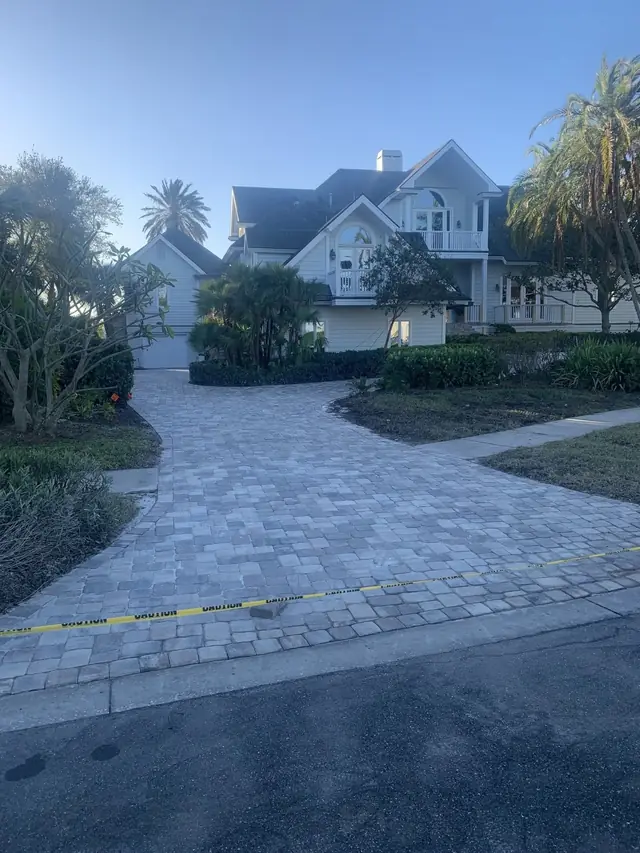
Few questions come up on a driveway estimate as often as this one. Should it be poured concrete, or pavers? The honest answer is that both perform well in Florida when they're installed correctly. Neither is the wrong choice. They just behave differently over time, and the right one depends on your budget, your tolerance for upkeep, and how the property drains.
How concrete behaves
A concrete driveway is poured as a single surface and cures in place. That's its biggest strength and its main trade-off. It is typically lower in upfront cost than pavers, and it asks less of you afterward. Routine sweeping and periodic rinsing handle most of the cleaning, and sealing every 2 to 3 years protects against staining and moisture.
The trade-off is that a single surface is repaired as a single surface. If a section settles or cracks, you can't lift out one piece and drop in another. That is one reason the work underneath matters so much, and why we evaluate soil, drainage and grade before anything is poured.
Concrete also gives you plenty of design room that people don't always expect. Finishes include plain concrete, colored concrete, exposed aggregate, and textured or broom finishes, with decorative borders or score lines if you want a pattern. You can see the range on our Driveways and Pathways page.
How pavers behave
Pavers are individual units set over a prepared base. They cost more initially, but they trade that for flexibility. If one cracks or stains, it can be swapped out on its own without disturbing the rest. In certain configurations they can also help with drainage, and they offer more design options in pattern and layout.
The catch is that pavers want some attention. Sealing is optional but available at installation or as a standalone service, and a sealed surface should be resealed about every 3 to 5 years depending on sun exposure, traffic and the sealer used. A paver surface is only as good as the base underneath, so a shifted or sunken area usually tells you something about the base rather than the units themselves. Our Paver Services page covers installation, repair and restoration if you already have a paver drive that needs work.
Side by side
- Upfront cost: concrete is typically lower, pavers cost more at the start.
- Upkeep: concrete needs less ongoing maintenance. Pavers may need resealing every 3 to 5 years if you choose to seal them.
- Repairs: concrete is repaired as one surface. Pavers allow targeted repairs, one unit at a time.
- Drainage: pavers can improve drainage in certain configurations. Concrete relies on a well designed grade.
- Design: both can look great, though pavers offer more pattern and layout options.
What the timeline looks like
For a concrete driveway, most residential projects take 3 to 5 days from site prep through the pour, plus curing time. After that, plan on waiting at least 24 hours before anyone walks on it, and 7 full days before a vehicle goes on it. That last part catches people out. The surface looks finished long before it's ready to carry a truck, so keep cars on the street for the full week. You'll get a specific timeline for your driveway during the free estimate.
How to decide
If you want the lower upfront cost and the least maintenance, concrete is usually the answer. If you want the ability to fix one damaged spot without touching the rest, or you care about a particular pattern, pavers are worth the extra. And if your lot has drainage quirks, the answer may depend on the site itself, which is why we look at the property before recommending either one.
We'll walk you through the trade-offs for your specific property. Reach us through the contact page, or call Perkins Concrete at (727) 531-2545 to set up a free on-site estimate. Residential estimates happen within 36 hours.
Perkins Concrete, (727) 531-2545
Call (727) 531-2545More articles
Why Florida Concrete Cracks, and Why the Surface Is Rarely the Cause
Most concrete failures in Florida start below the slab, which is why a patch on top so often fails to hold.
How to Keep a Florida Pool Deck Cool Underfoot
A pool deck should be comfortable at noon, not just good looking at sunrise. Color and texture decide which one you get.