Flatwork · Pour 01
Concrete driveways and pathways, poured on a base we checked first.
Plain, colored, exposed aggregate, textured and broom finishes, with decorative borders or score lines. Pathways too, and walkways that pool get fixed at the grade.
Chapter 01
Finishes: plain, colored, exposed aggregate, broom
A driveway is one of the first things anyone sees when they pull up to your property, and it takes vehicle weight, foot traffic, Florida heat and the rainy season, every day. Concrete is the most durable surface for the job. It handles the weight, resists moisture, and holds up in heat without softening the way asphalt can.
Then comes the finish. Perkins pours plain concrete, colored concrete, exposed aggregate, and textured and broom finishes, with decorative borders or score lines when you want the drive to look drawn rather than just poured. Exposed aggregate shows the stone in the mix instead of hiding it. Broom and textured finishes sit at the plain, practical end of the list.
The finish is the last decision, not the first. Before anyone argues about color, the ground gets read.
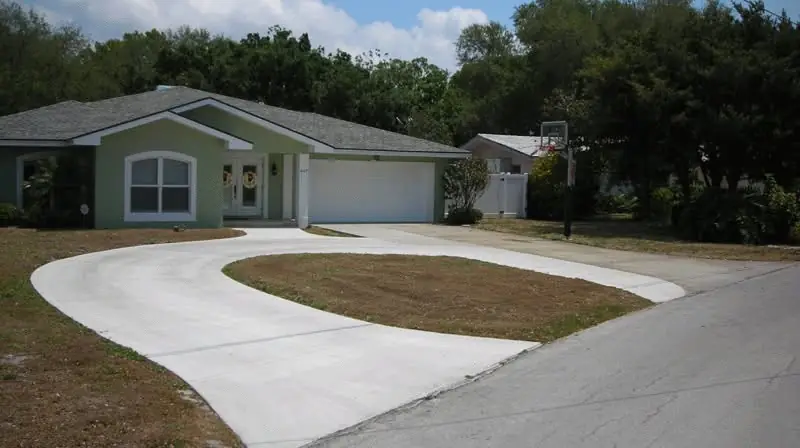
Broom-finished concrete driveway looping in front of a green Florida house
Under the finish: sub-base, reinforcement and grading
In Florida, drainage and sub-base preparation are the two factors that most determine how long a driveway holds up. Soil conditions in the Tampa Bay area shift with moisture, and a surface that isn't graded properly sends water toward your foundation instead of away from it.
So every driveway starts with a site evaluation of soil stability, existing drainage patterns and grade, before any material goes down. That process doesn't change based on the size of the job. The concrete that follows is built with proper sub-base preparation, reinforcement, and grading to direct water away from your structure.
Chapter 03
Pathways, and the walkway that pools water
A walkway that holds water after rain is a grade problem, not a surface problem.
Perkins builds new pathways and repairs walkways that pool, and handles every phase: planning, installation and finishing. If the water sits, the fix starts with where the water is supposed to go. Whether that means a new pour or a repair is something you hear plainly after the site evaluation, before anyone recommends a scope.
How long it takes, and when you can drive on it
Most residential driveways take 3 to 5 days from site prep through pour, plus curing time. You get a specific timeline during your free estimate. We recommend waiting at least 24 hours before foot traffic and 7 full days before vehicle use, so park on the street and let it cure.
After that, upkeep is light. Routine sweeping and periodic rinsing handle most of it. Seal every 2 to 3 years to protect against staining and moisture, and address cracks early before they spread. Maintenance guidance is given at project completion.
Family-owned and operated in the Tampa Bay area since 1989. Veteran owned, License #CPC1457580, and every job is backed by a workmanship warranty.
Weighing a different surface? Paver driveways cost more up front but can be repaired one unit at a time. A driveway that ends at a patio is a related pour, and concrete patios follow the same rule: structure first, texture and color after. If you already know what you want poured, send the job details and Warren Perkins’ crew will set up the site visit.
Before you pour